

In Singapore’s industrial landscape, flooring is far more than an aesthetic decision, it is an operational asset. A properly specified floor system influences safety, productivity, contamination control, equipment lifespan, and regulatory compliance. In high-performance environments like food factories, logistics hubs, cleanrooms, and manufacturing facilities, flooring failures can cause contamination risks, downtime, product loss, and costly reinstatement works.
As businesses expand and build more sophisticated facilities, the choice between epoxy flooring and polyurethane (PU) flooring has become an important engineering consideration, especially with increasing focus on hygiene certifications, HAACP/ST/NEA/SFA requirements, and International Standards adoption in Singapore.
This guide compares Epoxy vs PU flooring systems in depth, breaking down their chemical behavior, practical suitability across industries, lifecycle performance, and climate-specific considerations for Singapore. Whether you are planning a new facility or upgrading for higher compliance, this 2025 definitive comparison will serve as your technical reference.
2. Understanding Epoxy Flooring Systems
2.1 What is Epoxy Flooring?
Epoxy flooring is a thermosetting polymer formed through a chemical reaction between epoxy resin and hardener. Once cured, the material forms a cross-linked matrix that is extremely dense, rigid, and highly resistant to compression. This molecular structure gives epoxy its characteristic hardness, chemical resistance, and mechanical durability — qualities that make it widely used in modern industrial and commercial flooring environments.
In Singapore, epoxy flooring systems range from simple roller-applied coatings to advanced self-levelling epoxy systems. Self-levelling epoxy coatings provide a perfectly smooth, high-gloss finish that hides surface imperfections—a popular choice in aesthetic and heavy-duty industrial applications. Roller-applied epoxies tend to have a thinner thickness and a rougher texture known as an “orange peel” effect.
Key properties include:
- High compressive strength, ideal for heavy equipment and pallet loads
- Seamless and non-porous surface, aiding hygiene and cleanability
- Excellent chemical resistance, particularly to oils, alkalis, solvents
- Strong adhesion to substrate, when installed under correct surface preparation
However, epoxy’s rigidity means it has limited elasticity. In environments subjected to substrate movement, thermal shock, or impact vibration, epoxy may be prone to stress cracking if not engineered correctly with appropriate underlays and expansion details.
Types of Epoxy Flooring Systems
| System Type | Thickness | Typical Usage |
| Roller-Applied Epoxy | 0.6mm to 0.8mm | Light industrial, retail, light traffic workspaces |
| Self-Smoothing Epoxy | 2–5mm | Warehouses, production areas, logistics floors |
| Epoxy Screed / Mortar | 5–9mm | Heavy-duty manufacturing, damaged substrate correction |
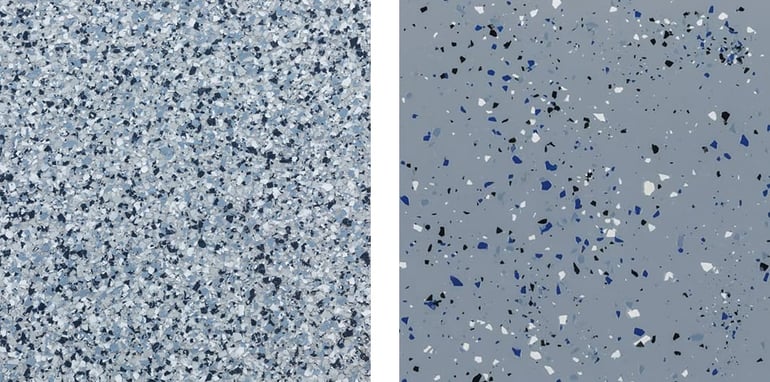
| Epoxy Flake / Quartz System | Custom | Decorative commercial & institutional environments |
| ESD Epoxy | 1.3 – 1.5mm | Precision electronics, semiconductor, cleanrooms |
2.2 Epoxy Flooring Applications in Singapore
Epoxy remains a go-to solution across many Singapore sectors due to its versatility and cost efficiency in large-scale installations. Epoxy coatings also serve heavily in industrial flooring contexts, including warehouses, manufacturing plants, and heavy-duty commercial garages. Their robustness makes them ideal for areas experiencing significant wear and chemical exposure. Commercial uses extend to showrooms and hospitals where hygiene and durability are essential.
Industrial Environments
- High-volume logistics centres
- Light to heavy manufacturing plants
- Precision engineering workshops
- Mechanical & automotive facilities
- Maintenance depots & aircraft service bays
Highly suitable for warehouse epoxy flooring with forklift traffic and pallet systems due to excellent abrasion resistance and smooth finish for rolling loads.
Commercial & Institutional Spaces
- Retail and showrooms
- Schools and sports facilities
- Clinics and medical offices
- Exhibition environments
2.3 Epoxy Performance Characteristics
Epoxy floors excel at chemical resistance, handling acids, solvents, and alkalis commonly encountered in industrial settings. Their hard, inflexible nature contributes to excellent abrasion resistance and long lifespan, but may limit impact absorption.
Aesthetic options include high gloss finishes and an array of colors and textures. However, epoxy coatings can be brittle and prone to cracking under extreme temperature cycling or heavy mechanical impact.
Epoxy is valued for:
| Strengths | Notes |
| High surface hardness | Exceptional against scratches, abrasion, rolling loads |
| Strong chemical resistance | Oils, industrial chemicals, alkaline cleaners |
| Aesthetic versatility | Gloss, semi-gloss, flake, quartz, metallic options |
| Cleanroom suitability | Available in anti-static and ESD systems |
Practical Limitations
- Lower tolerance to thermal shock (e.g., hot water washdowns)
- Rigid structure makes it less forgiving to substrate movement
- Potential for UV yellowing without a protective finish
- Moisture-sensitive during curing — requiring experienced applicators and correct humidity management
3. Understanding PU Flooring Systems
3.1 What is Polyurethane Flooring?

image source: technicalfinishes
Polyurethane flooring is another high-performance thermoset system, but chemically engineered to provide flexibility, elasticity, and enhanced thermal shock resistance. PU systems are particularly associated with food, beverage, pharmaceutical, and hygiene-critical facilities.
Polyurethane flooring is a flexible polymer coating system designed to absorb impact and resist scratches better than epoxy. Chemically, PU floors integrate elastic properties that make them ideal for areas subject to thermal expansion and heavy foot traffic. PU flooring variations include elastic self-levelling systems, which provide a matte or satin finish with higher comfort underfoot compared to epoxy coatings.
PU chemistry also allows the floor to absorb mechanical vibration and thermal expansion more effectively than epoxy, a crucial feature for Singapore’s F&B processing sector, where facilities undergo hot washdowns, steam cleaning, freezer transitions, and aggressive sanitation cycles.
Types of PU Flooring Systems
| PU System | Characteristics | Best Use |
| PU Coatings | Thin, protective | Light commercial, protective top coats |
| PU Medium Duty | Semi-flexible & seamless | Food processing floors, hygiene environments |
| PU Heavy Duty | Extremely high chemical & thermal resistance | Breweries, slaughterhouses, industrial kitchens |
3.2 PU Applications in Singapore
PU floors are increasingly preferred in the food and beverage industry due to their hygienic, seamless finish that is easy to clean and resistant to thermal shock and chemical exposure associated with food processing.
They are also excellent for high-traffic commercial spaces needing slip resistance and impact absorption, such as central kitchens and office floors.
PU flooring is highly preferred in:
- Food & beverage production facilities
- Central kitchens & cloud kitchen operations
- Cold rooms and freezer stores
- Breweries, dairies, meat & seafood plants
- Pharmaceutical cleanrooms
- Healthcare laboratories
3.3 PU Performance Characteristics
| PU Advantage | Why It Matters |
| High Flexibility | Better impact and vibration absorption |
| Thermal Shock Resistance | Withstands sudden hot washdowns and chilled environments |
| Chemical and Acid Resistance | Handles lactic acids, sugars, and organic food byproducts |
| Anti-microbial options | Meets strict hygiene and HACCP requirements |
| Non-porous seamless finish | Superior sanitation control |
PU systems can withstand direct exposure to steam cleaning, boiling water, and deep-freeze temperature cycles, making them the most reliable flooring choice for wet-processing environments.
4. Epoxy vs PU Flooring Direct Comparison Analysis

Choosing between epoxy and polyurethane (PU) flooring is not merely a matter of preference-it is a technical decision that directly affects operational efficiency, regulatory compliance, long-term cost, and asset protection. While both materials are high-performance resin floors used across Singapore’s industrial and commercial sectors, they behave very differently under stress, temperature change, mechanical loads, and hygiene requirements.
This section provides a deeper technical interpretation of how the two systems compare across performance, cost, and application suitability.
4.1 Performance Factors: Detailed Breakdown
While epoxy and PU are often grouped as “industrial resin floors,” their underlying chemistry leads to distinct behaviour in real-world environments. The table below summarises the key performance attributes, followed by an in-depth analysis of each category.
Performance Comparison Table
| Category | Epoxy | PU |
| Hardness | High | Medium-high (more elastic) |
| Flexibility | Low | High |
| Thermal Shock Resistance | Limited | Outstanding |
| Chemical Resistance | Excellent (alkali & oils) | Excellent (acids, lactic acid, organic food acids) |
| Hygiene Rating | Good | Highest (HACCP-preferred) |
| Wear Resistance | Excellent | Excellent |
| Cost | Lower upfront | Higher upfront, lower lifecycle cost |
| UV Resistance | Needs UV-stable topcoat | Higher intrinsic UV resistance |
Deeper Analysis of Epoxy vs PU flooring
Hardness & Mechanical Strength
Epoxy is inherently harder and more rigid. This is advantageous for:
- heavy loads
- forklift routes
- pallet storage zones
- high point-load racking systems
Its compression strength makes it a preferred choice for factories, logistics hubs, and manufacturing lines.
By contrast, PU has a slightly softer but highly elastic structure. This elasticity helps absorb:
- impact forces
- thermal expansion and contraction
- vibrations from heavy machinery
This is why PU floors outperform epoxy in environments with rapid temperature shifts, hot washdowns, or freezer-to-ambient transitions.
Flexibility
Epoxy’s low flexibility makes it prone to cracking when:
- the substrate moves,
- temperature fluctuates rapidly,
- or heavy impact occurs.
PU, however, is engineered to deform slightly without cracking. Its flexibility prevents shear-line failures and makes it ideal for:
- food processing
- semiconductor and cleanroom corridors
- carparks with temperature changes
- manufacturing facilities with vibration-heavy equipment
Thermal Shock Resistance
This is one of the clearest differentiators.
- Epoxy performs well under stable temperature conditions, but may crack when subjected to shock such as:
- steam cleaning,
- hot-water washdowns,
- freezer thresholds,
- or open-flame cooking environments.
- PU is specifically formulated to withstand extreme temperature cycling, often handling:
- -40°C to +120°C conditions,
- steam cleaning (up to 120°C),
- daily hot washdowns,
- rapid freezer door operations.
This makes PU the gold standard for:
- central kitchens
- food plants
- cold storage facilities
- dairies and breweries
- pharmaceutical processing
Chemical Resistance
Both materials offer strong performance, but their strengths differ by chemical type.
Epoxy excels in:
- alkalis
- solvents
- oils and petrochemicals
- industrial chemicals common in manufacturing
PU excels in:
- acids (especially organic acids)
- lactic acid (critical in dairy environments)
- acidic foods (fruit juices, vinegar)
- sugar-rich environments (bakeries, confectionery plants)
This distinction is why PU is widely preferred for:
- F&B facilities
- breweries
- dairy plants
- food science labs
Hygiene & Compliance
Epoxy can achieve good hygiene levels when applied as a seamless system. However, it is not optimised for environments with:
- hot water sanitation,
- aggressive disinfectants,
- or food-based acidic exposure.
PU, particularly self-smoothing and heavy-duty PU screeds, is:
- NSF rated,
- HACCP-preferred,
- resistant to microbial growth,
- and compliant with Singapore’s SFA and AVS hygiene requirements.
Its non-porous structure and resistance to thermal/chemical stress make it unmatched for:
- meat processing
- seafood processing
- central kitchens
- pharmaceutical plants
UV Resistance
Epoxy tends to amber or fade under UV exposure unless a UV-stable polyurethane topcoat is added.
PU inherently has much better UV stability, making it preferred for:
- carparks,
- loading bays,
- outdoor walkways,
- areas with skylights or glass façades.
4.2 Cost: Installation vs Lifecycle
Cost considerations are critical for Singapore operators, especially in long-term asset planning. While epoxy and PU differ in upfront cost, the more meaningful comparison lies in lifecycle economics.
Cost Comparison Table
| Cost Variable | Epoxy | PU |
| Initial Investment | Lower | Higher |
| Maintenance Needs | Medium | Low |
| Repair Frequency | More frequent in harsh-use areas | Less frequent |
| Service Life (well-maintained) | 5–10 years | 7–15+ years |
Interpretation & Cost Dynamics
Initial Investment
Epoxy flooring is generally 30–50% cheaper upfront because:
- it requires fewer layers,
- uses simpler formulations,
- and installation is faster.
This makes epoxy attractive for large floor areas such as:
- warehouses,
- storage units,
- light manufacturing plants.
PU, especially PU screeds and high-build self-smoothing systems, costs more due to:
- advanced chemical formulation,
- multi-layer installation,
- specialised labour requirements.
Maintenance Needs
Epoxy requires periodic re-topcoating in high-wear environments. Over time, micro-cracks or wear lines may appear from:
- forklift turning zones,
- abrasive particles,
- heat or chemical exposure.
PU requires significantly less maintenance because:
- it is more elastic,
- withstands extreme temperatures,
- resists chemical degradation,
- and maintains surface integrity longer.
Repair Frequency
In facilities with heavy mechanical action or temperature fluctuations, epoxy may require:
- patch repairs every 2–4 years,
- re-coating in forklift aisles,
- crack remediation around machinery.
PU generally requires:
- fewer interventions,
- less patching,
- and fewer shutdowns.
For 24/7 operations (common in Singapore logistics and F&B), these reduced shutdowns translate into major operational savings.
Service Life & Lifecycle Value
Although PU costs more upfront, its longer lifespan and lower maintenance cost often result in lower total cost of ownership (TCO) over 10–15 years.
- Epoxy may need major renewal in ~7 years.
- PU often lasts 12–15 years before major restoration.
Thus, PU is more cost-effective in:
- thermally active environments,
- hygiene-critical areas,
- heavy chemical zones,
- high-impact facilities.
Epoxy remains more economical for:
- dry industrial settings,
- standard logistics,
- low-chemical manufacturing lines.
4.3 Application Suitability Overview
Different industries require different performance characteristics. The table below summarises the recommended flooring choice based on common facility types in Singapore.
Application Suitability Table
| Facility Type | Best Fit |
| Dry manufacturing & logistics | Epoxy |
| Heavy forklift traffic | Epoxy |
| Cold rooms, freezers | PU |
| Hot washdown zones | PU |
| HACCP-regulated areas | PU |
| Electronics & ESD control | Epoxy ESD systems |
| Mixed-use industrial environments | Hybrid strategy |
Interpretation & Practical Notes
Where Epoxy Excels
Epoxy is typically favoured for:
- factories (general manufacturing)
- distribution centres
- assembly lines
- tooling workshops
- warehouses
- electronic component facilities (with ESD epoxy)
Reasons include:
- superior hardness
- strong mechanical strength
- cost-effective installation
- broad chemical resistance
- wide aesthetic variation
Epoxy can also be enhanced with:
- ESD properties,
- anti-slip profiles,
- high-build coatings,
- self-levelling formulations.
Where PU is the Clear Winner
PU is the premium choice for:
- food processing plants
- cold storage facilities
- central kitchens
- commercial bakeries
- breweries, dairies, beverage plants
- pharmaceutical & biomedical facilities
Reasons include:
- extreme thermal resistance
- ability to withstand hot-and-cold cycling
- best-in-class hygiene characteristics
- resistance to acidic food chemicals
- better shock absorption
Hybrid Flooring Strategies
In modern industrial complexes, hybrid systems are increasingly common-especially in Singapore where mixed-use industrial operations share the same building.
Examples:
- Epoxy in loading bays, warehouses, and packaging zones.
- PU in production halls, wet areas, cold rooms, or where food handling is involved.
- Epoxy ESD in cleanrooms or electronics assembly areas.
Hybrid installs offer:
- cost optimisation,
- performance maximisation,
- compliance with sector-specific regulations.
5. Singapore-Specific Considerations
Singapore’s climate and regulatory environment influence resin floor selection significantly:
| Local Factor | Epoxy Impact | PU Impact |
| Tropical Humidity | Sensitive during curing | More forgiving |
| Thermal Cycling | May crack | Ideal |
| SFA/NEA/Food-safe Standards | Acceptable | Preferred |
| Local Installer Expertise | Broader base | Specialist-required |
PU cementitious systems are often selected in new-build F&B plants due to strict hygiene and steam-cleaning needs, whereas epoxy dominates warehousing and manufacturing.
6. Industry-Specific Recommendations
6.1 Food & Beverage
In Singapore’s F&B sector, flooring must comply with SFA standards and support HACCP-certified workflows, meaning surfaces must be non-porous, easy to sanitise, slip-resistant, and able to withstand aggressive cleaning chemicals. PU flooring is often preferred in wet and thermal-stress environments because it handles hot water washdowns, steam cleaning, and sudden temperature swings without cracking. Epoxy still has a role, particularly in dry, low-impact areas.
| Area | Recommended Flooring |
| Production Rooms | PU – superior thermal shock and chemical resistance |
| Dish-washing / Sink Zones | PU – resists continuous moisture and heat |
| Chillers/Freezers | PU – remains stable in sub-zero conditions |
| Dry Storage / Packaging | Epoxy – economical and sufficient for low-moisture zones |
Overall, PU provides a safer, longer-lasting solution for wet processing, while epoxy remains cost-effective in dry, non-thermal environments.
6.2 Manufacturing & Warehousing
Industrial facilities demand flooring systems that withstand constant abrasion, heavy machinery loads, chemical exposure, and forklift traffic. Epoxy is commonly chosen for its hardness and wear resistance, while PU is specified where chemical resilience or temperature fluctuations are core concerns. The choice depends heavily on the operational profile of each area.
| Application | Best Option |
| General Manufacturing | Epoxy – strong, durable, and economical |
| Chemical Production | PU – better resistance to acids, solvents, and corrosives |
| Heavy Forklift Aisles | Self-levelling Epoxy – smooth, impact-resistant ride paths |
| Machine Bases | Epoxy Mortar – extremely high compressive strength |
Tailoring the system to the load type – dynamic, static, or chemical – ensures durability and lowers maintenance downtime.
6.3 Electronics & Clean Rooms
Electronics manufacturing, data centres, and cleanrooms require flooring that controls electrostatic discharge (ESD) and produces minimal particulate contamination. Epoxy-based ESD systems provide predictable conductivity and seamless finishes that comply with ISO cleanroom standards. PU is used selectively in areas requiring additional chemical protection or exposure to temperature shifts.
| Zone | Flooring System |
| Assembly & Cleanrooms | ESD Epoxy – consistent static dissipation and dust control |
| Chemical Mixing / Freezers | PU – chemical resistance and temperature stability |
These environments benefit from systems that combine conductivity, hygiene, and mechanical durability, ensuring product safety and regulatory compliance.
7. Installation Considerations
| Factor | Epoxy | PU |
| Application Requirements | Skilled | Specialist required |
| Odour Levels | Low | Higher |
| Curing Time | 24–72 hrs | 48–96 hrs |
| Humidity Sensitivity | High | Medium |
Epoxy systems generally require skilled applicators, while PU flooring often needs specialist installers due to its faster reaction time and stricter mixing controls. Epoxy emits low odour during installation, whereas PU can release stronger fumes and may require additional ventilation. Curing times also differ: epoxy typically needs 24–72 hours before use, while PU may take 48–96 hours depending on the system thickness and humidity.
Epoxy is more sensitive to moisture and humidity fluctuations, making tropical installations trickier without proper environmental control. PU is slightly more forgiving but still requires careful monitoring. Regardless of system choice, correct moisture barriers, substrate preparation, and site conditioning are essential – long-term performance depends on teams who understand Singapore’s high-humidity environment.
8. Maintenance & Longevity
Maintenance plays a decisive role in how long epoxy and PU flooring systems perform in demanding industrial environments. While both are durable, their upkeep requirements differ due to their material properties and the types of stress they encounter.
Maintenance & Longevity Comparison
| Maintenance Aspect | Epoxy | PU |
| Cleaning Method | Standard industrial cleaning; neutral detergents; not suitable for repeated hot-water sanitation | Tolerates hot water, steam, and aggressive disinfectants; ideal for hygiene-critical zones |
| Recoat Frequency | Higher; often required in heavy traffic or forklift turning zones | Lower; maintains surface integrity longer |
| Lifespan | 5–10 years | 7–15+ years |
Daily Cleaning & Upkeep
Epoxy performs well with routine sweeping, auto-scrubbing, and neutral pH detergents. However, it is more sensitive to high-temperature water, acidic cleaners, and thermal cycling, which can cause microcracks and reduce gloss over time.
PU is far more robust during sanitation procedures. It can withstand:
- hot-water washdowns,
- steam cleaning,
- strong disinfectants,
making it ideal for F&B, pharma, and cold-chain environments where daily sanitation is mandatory.
Recoat & Repair Requirements
Epoxy’s rigidity means it may show:
- wear marks,
- UV yellowing,
- surface abrasion,
- cracking in high-stress areas.
As a result, epoxy floors typically require recoating every 2–4 years in heavy-use areas and every 4–7 years in standard industrial settings.
PU’s elastic structure and superior chemical resistance significantly reduce wear. Most PU systems require minimal patch repairs and only need major recoating every 7–12 years, even under aggressive conditions.
Overall Lifespan
- Epoxy: 5–10 years depending on mechanical load, heat exposure, and maintenance.
- PU: 7–15+ years, especially in environments with hot water sanitation or thermal shock.
Best Practices (Both Systems)
- Use daily auto-scrubbing with appropriate pads.
- Apply cleaners matched to the floor’s chemical resistance.
- Conduct periodic inspections in forklift aisles and loading zones.
- Schedule recoating before visible wear becomes structural.
With consistent cleaning and preventive maintenance, both epoxy and PU floors can exceed their expected lifespan and deliver strong long-term value.
9. Decision Framework
Ask these questions:
- Will the area experience hot water cleaning or steam?
- Are hygiene and food-grade certification required?
- What is the load and traffic pattern?
- Will chemicals be primarily alkaline or acidic?
- Is there cold room or freezer exposure?
- What is the expected operational lifespan before renovation?
In general:
- Epoxy = cost-efficient, heavy-load, dry industrial spaces
- PU = hygiene zones, wet environments, thermal shock, food plants
10. Conclusion & Expert Consultation
The right flooring is a long-term operational decision. While epoxy is ideal for large-area industrial and warehousing environments, PU remains superior for food processing, pharmaceutical facilities, and any space requiring exacting hygiene and thermal performance.
With Singapore’s increasingly regulated industrial standards and rising food production & cleanroom sectors, selecting the correct system from day one minimises downtime, compliance risk, and operational cost over time.
For a technical evaluation, surface inspection, and system recommendation, speak with Asset Protection Services, specialists in industrial flooring solutions engineered for Singapore’s toughest environments.


